Transferring Students Into Piano Safari
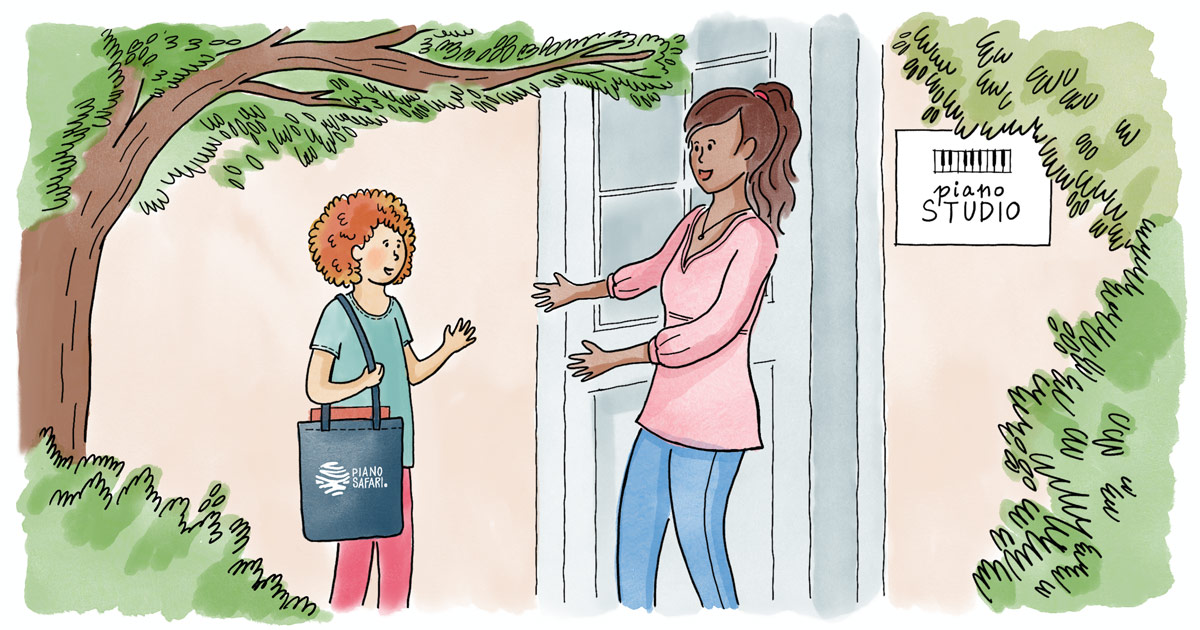
When we welcome a new transfer student to our studios or find it necessary to change the method used by a current student, it can often be difficult to know what level will be most appropriate in the new series. Many factors must be considered such as the student’s current level and age, their particular strengths and weaknesses, and their individual interests. In addition, we must be familiar with how books from the different method series compare. Due to this, there is not a “one size fits all” recommendation that works for everyone. There are, however, general principles that will assist in the decision making process. In this Field Note, I will provide some of the best practices for transferring a student into Piano Safari from another method.
The Unique Characteristics of Piano Safari
Piano Safari is unique in that its earliest levels provide pieces that are to be learned by rote, away from notation. These rote pieces are more advanced than the student’s reading level, and are designed to develop technique as well as an understanding of pattern and form, artistry, and creativity (just to name a few benefits!). If you are interested in learning more about the “why” behind rote teaching, I suggest that you read the Field Note The Rationale for Rote Teaching before continuing with this article.
Due to the inclusion of rote pieces, it is inadvisable to directly compare Piano Safari Friends or Level 1 with the primer book of another method that does not contain rote pieces. A student who completes a beginning book in another series may learn about reading and theory, but will miss out on the many benefits rote pieces provide. Additionally, Piano Safari includes researched-based technique exercises that provide the foundational gestures needed for free, fluent, and artistic playing. Read more about the Piano Safari technical approach in the article Foundations of Beginning Technique.
Early Elementary Level Students
Because of the aforementioned points, if you desire to transfer an early elementary level student into Piano Safari, it is absolutely advisable to start from the beginning, in Piano Safari Friends (students ages 4-6), Piano Safari Level 1 (students ages 6-11), or Piano Safari for the Older Student Level 1 (students ages 12 through adult).
Sometimes teachers worry that students may feel like they are “starting over” if they restart in Level 1, but we have not found this to be the case due to the fact that the rote pieces are at a higher level than the students have played in their previous primer level method book. Piano Safari is so different from other methods that students will enjoy the novelty and be appropriately challenged. In addition to learning the technique and rote pieces, students will also be integrated into the intervallic reading and landmark based system used in Piano Safari. For more on this topic, visit Foundations of Music Literacy: Intervallic Reading Part 1 and Part 2.
Elementary Level Students
A student at the elementary level may have already had a year or two of piano study and be in the second level of another method. Before you transfer a student at this stage into Piano Safari Level 2, we recommend that you introduce the animal techniques from Level 1, and also teach at least some of the initial Level 1 rote pieces. It will also be helpful to test the student’s reading ability by taking them through the last few colors of the Sight Reading & Rhythm Cards, (Levels C, D & E) which include the intervals of 2nds and 3rds. It will be very difficult for a student to achieve success in Piano Safari Level 2 without having achieved these initial skills.
There are two supplemental books available for this purpose: Pattern Pieces Book 1 (includes the Level 1 rote pieces) and Animal Adventures (includes the animal techniques, improvisations, and corresponding rote pieces). These supplemental books may be used to “catch a student up” with vital concepts before they fully enter Piano Safari Level 2. They can also be used alongside another piano method to aid students in the transition.
Students who have completed these Level 1 prerequisites will be ready to enter Piano Safari Level 2 (ages 7-11) or Piano Safari for the Older Student Level 2 (ages 12 through adult).
Late Elementary Students
Most late elementary students will have studied piano for at least three or four years, and are likely in the third level of another method. These students are able to play early level classical repertoire in a graded anthology series.
At this stage, it is typically straightforward to transfer a student directly into Piano Safari Level 3 or Piano Safari for the Older Student Level 3. With this said, if there are any technical deficiencies, I wholeheartedly suggest teaching the Piano Safari Level 1 animal techniques and making sure the student is comfortable with playing all of the major and minor pentascales and triads introduced in Technique Book 2.
As an additional note, I have found that some college piano majors have received major benefit from learning the animal techniques, even at their advanced stage of study. These are foundational techniques that all pianists should master in order to tackle more difficult repertoire and play musically.
If the student needs more practice with basic reading concepts, it is advisable to go back through the Level 2 Sight Reading & Rhythm Cards. Select a few cards from each color group. If the student plays them accurately, move on. If they begin to stumble or hesitate, work through all of the cards in the group before moving ahead.
A Quick Guide
Early Elementary students who have studied piano for 1-2 years:
- Start over in Piano Safari Friends, Level 1, or Older Student Level 1
Elementary students who have studied piano for 2-3 years:
- Teach the Level 1 animal techniques (Animal Adventures)
- Teach some of the Level 1 rote pieces (Pattern Pieces 1)
- Test reading knowledge (Sight Reading & Rhythm Cards 1 Levels C, D and E)
- Begin Piano Safari Level 2 or Piano Safari for the Older Student Level 2 when these prerequisites are complete
Late Elementary Students who have studied piano for 3-4 years:
- Teach the Level 1 animal techniques (Animal Adventures)
- Teach the major & minor pentascales (Technique Book 2)
- Test reading knowledge (Sight Reading & Rhythm Cards Level 2)
- Begin Piano Safari Level 3 or Piano Safari for the Older Student Level 3
For more information on what to do after this stage of study, read the Field Note Where To Go After Piano Safari Level 3?
Summary
Before transferring a student into Piano Safari, consider their current level, age, and particular strengths and weaknesses. Make sure the Piano Safari Level 1 skills are mastered, particularly in the area of technique and reading. If you aren’t sure what level is appropriate, it is always best to error on the side of “too easy” rather than “too hard.” It is vitally important to shore up and strengthen the student’s understanding of foundational musical concepts rather than move too fast. This will allow them to thrive and develop into lifelong musicians.


