Supplemental Repertoire for Piano Safari Levels 2 & 3
Less is More
After reading the title of this article, you may be wondering why I am not starting with a discussion about supplemental repertoire that corresponds with Piano Safari Level 1. The short answer is that I do not typically assign students extra books when they are just beginning lessons. Why? At this stage, it is my opinion that less is more. It is important that students build a strong foundation in their first few years of lessons, and in order to do that, they need focus and purposeful repetition. I’ve also found that the variety of pieces in Repertoire Book 1 provide more than enough material for a student who is just beginning their piano journey. The rote pieces build artistry and technique and serve as engaging recital repertoire, and the reading pieces and sight reading cards provide ample practice and drill with basic musical skills.
In addition, the intervallic reading approach in Piano Safari Level 1 is very specific, and it may confuse students if they use another book that introduces reading concepts in a different sequence. If you do want to add a book with supplemental repertoire, I suggest that it be a rote book such as Friends at Last by Amy Glennon. Another option is teaching some of the Follow the Leader pieces from Piano Safari Friends. There are also some great patterned pieces available in the standard classical repertoire. “A Little Porcupine” Op. 89, No. 8 by Kabalevsky comes immediately to mind.
With this said, I do often supplement holiday or sacred music at the very end of Piano Safari Level 1. The easiest pieces in The Joy of Christmas Book 1 are “Jingle Bell Jazz” and “Jazzy Old St. Nick.” Since these are still slightly more difficult than the reading pieces in the repertoire book, feel free to write in some additional finger numbers to aid students in their reading.
This is my opinion, but I am sure there are teachers out there who have found supplemental repertoire that works very well at this early stage. I am not at all saying it can’t be done well. I personally lean toward simplicity in all things, though, so it suits my personality and teaching style to build depth rather than breadth at this stage.
Supplemental Repertoire for Level 2
At the beginning of Piano Safari Level 2, students learn all of the note names on the grand staff. They also add intervals throughout the book, so by the end of Repertoire Book 2 they are playing pieces with 2nds, 3rds, 4ths, and 5ths. Additionally, the pieces have a variety of textures such as parallel motion, dovetailing, (passing the melody line between hands) and playing a melodic line with a simple accompaniment. This makes it much easier to find pieces from other books that correspond with the reading approach, so at this stage I start supplementing more frequently, basing my choices mainly on the student’s musical tastes and interests. I also consider their strengths and weaknesses.
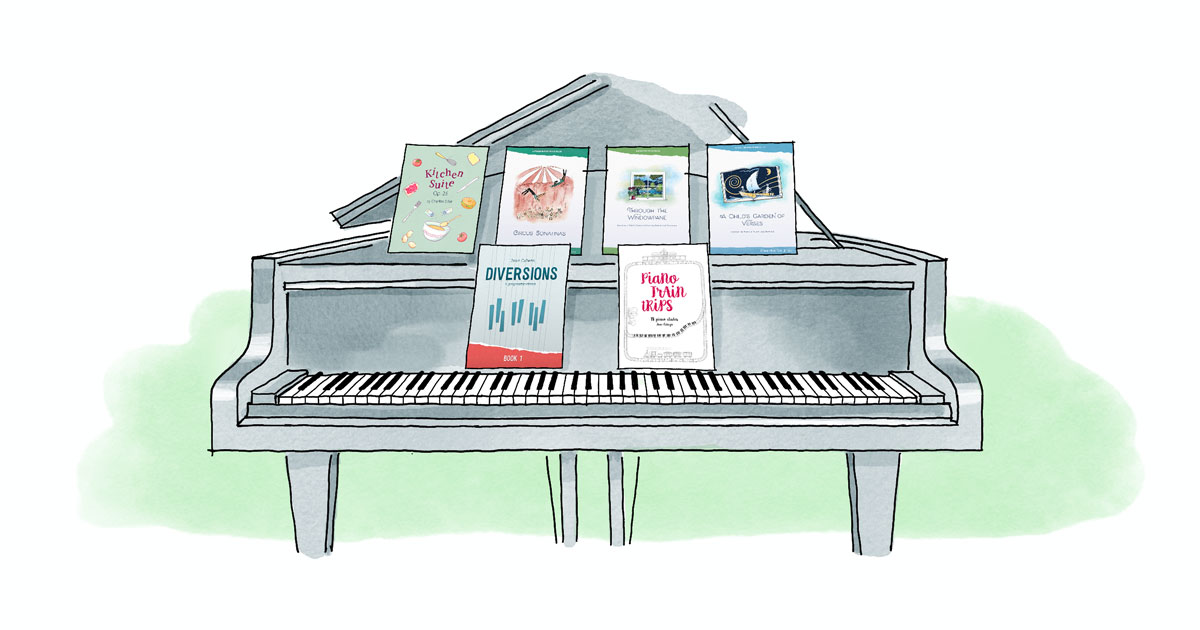
Following are some supplemental books from within the Piano Safari catalog that work quite well alongside Level 2. Of course there are many additional options from other publishers and composers as well, but the sheer quantity is beyond the scope of what I can include in this article.
Melodic Explorations Book 1
This elementary level duet book by Giulio Pietropaolo features simple pentascale-based melodies for the student. They are paired with vibrant teacher duets that make the students sound amazing! Melodic Explorations Book 1 is great for additional reading practice in common positions such as C Major, A Minor and D Minor. These duets also work very well for recital repertoire. You might even consider holding an ensemble recital where you pair a more advanced student playing the teacher part with a beginning student. This can be quite motivational, and it also provides a leadership opportunity for the more experienced pianist. Watch the video sampler here.
Diversions Book 1
Do you want to build upon your student’s natural creativity by teaching them to identify patterns and modify them? Diversions by Juan Cabeza is perfect for this purpose. Each piece features a simple pattern that may be taught either by reading or by rote, depending on where the student is in their study. Once the piece is learned as written, Juan encourages students to transpose (suggested keys are included) and also modify. For example, in "Diversion 1," students might modify by inverting the LH melodic line, playing groups of notes in the measure blocked, changing the octave, or changing the rhythm. The possibilities are numerous!

Through the Windowpane
This collection of seven pieces by Chee-Hwa Tan draws a connection between poetry by Robert Louis Stevenson and music on the piano. Students are encouraged to use a variety of articulation and phrasing to interpret the poetry. The pieces in Through the Windowpane will provide a doable challenge for a student in Piano Safari Level 2. Some pieces may be taught by rote, as they are quite patterned and fit in the hands nicely. Chee-Hwa is adept at writing pedagogically appropriate repertoire that also enhances a student’s artistry.
If you have several students at this level, a theme recital is a wonderful option. You could assign a narrator to read the poem before each student plays, or ask each student to read their own poem before playing. There is no reason why we can’t add presentation and public speaking skills to our student’s training, right? Watch the video sampler here.
Holiday and Sacred Repertoire
- The Joy of Christmas Book 1 features teacher/student duets. The student parts are quite straightforward, but the teacher parts are far more complicated and frequently use jazz harmonies. I recommend practicing them before you play with a student, but they are immensely gratifying! Accompaniment tracks are available to aid students with home practice. Watch the video sampler here.
- The Joy of Christmas Book 2 also features teacher/student duets. This book may be used with students in Piano Safari Level 2 or 3. Watch the video sampler here.
- The Joy of Hymns Book 1 provides teacher/student duets of common hymns selected from different denominations. These arrangements include the lyrics, and are perfect for use at church or to enjoy at home. Watch the video sampler here.
Supplemental Repertoire for Level 3
Once students enter Piano Safari Level 3, they are reading intervals and identifying notes with fluency. Repertoire Book 3 introduces key signatures up to one sharp and flat, and also presents the intervals of 6ths, 7ths, and 8ths. Due to this, there is a wide world of supplemental late elementary repertoire that may be introduced while students are in this book.
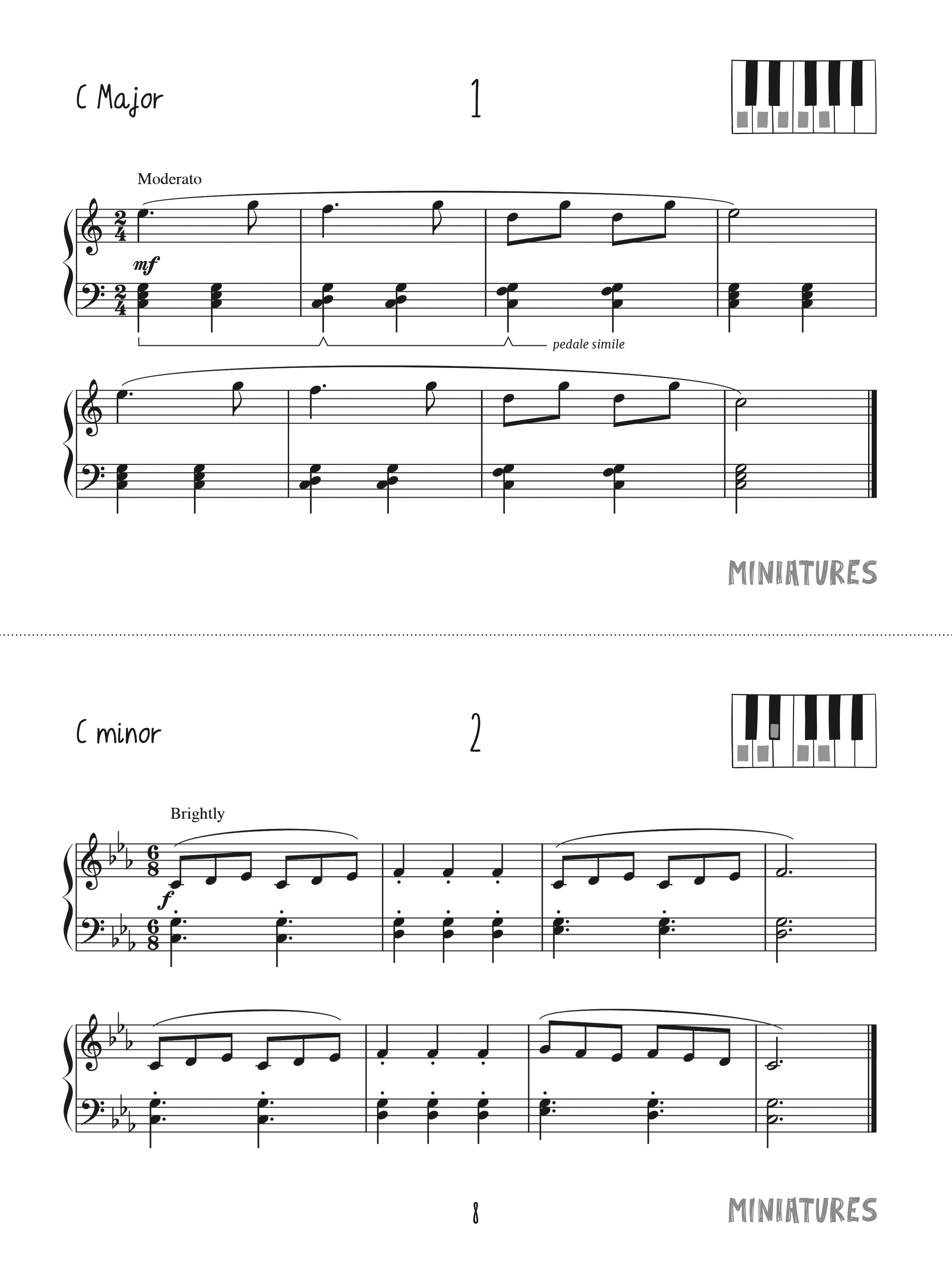
Miniatures
This book perfectly ties together reading and technique for students at the beginning of Level 3. It includes twenty-four short pieces in all keys that all remain within the pentascale position. This reinforces the student’s knowledge of the major and minor pentascales that were introduced in Technique Book 2 and were extensively reviewed at the beginning of Technique Book 3. Miniatures comes with flashcards that may be cut out and used for drilling the both the key signatures and pentascale positions.
In the book’s introduction, composer Juan Cabeza says the following:
Practicing pentascales creates the basis for solid technique and is an essential tool for developing musical comprehension. The pieces are written in different meters and styles with the intention of covering as wide a variety of piano textures as possible. The simplicity of the composition structure allows each piece to be easily transposed to other keys.
Circus Sonatinas
This set of two sonatinas by Chee-Hwa Tan is playful and fun. Here are her words about why she decided to write this collection back in 1996. In a conversation with a friend, they were discussing:
…the scarcity of early level sonatinas that explore sonata form and thematic structure in a musically and emotionally accessible way for young pianisits. To meet this need, I created the setting of a traditional circus as a vehicle for imaginative expression of contrasting themes.
These sonatinas are at a wonderful level for a student in Repertoire Book 3. In the updated edition of Circus Sonatinas (2024) Chee-Hwa also added creative tips and composer insights that will assist students in understanding the musical intent of each movement. Watch the video sampler here.
Kitchen Suite
This collection of pieces by Charles Stier is humerous and quirky. Each piece is composed in a specific form and style, but is given a title that relates to an item in the kitchen. Some examples of titles are “Bagel Bagatelle” and “Tunafish Toccata.” This fun theme engages the imagination of the student. I typically assign students pieces in Kitchen Suite when they are toward the middle or end of Repertoire Book 3. Watch the video sampler here.
Summary
Following is a comprehensive list of suggested materials for students who are in Piano Safari Level 2 or 3.
If you are looking for information about what to use beyond these levels, it may be helpful to read the article Where to Go After Piano Safari Level 3?
Core Materials: Level 2
- Repertoire Book 2
- Technique Book 2
- Sight Reading & Rhythm Cards 2
Supplemental Materials and Recital Repertoire: Level 2
- Melodic Explorations Book 1
- Diversions Book 1
- Through the Windowpane
- The Joy of Christmas Book 1 and 2
- The Joy of Hymns Book 1
Card Supplements: Level 2
- Major Triads
- Minor Triads
- Note Name Cards
- Piece Cards 2
Core Materials: Level 3
- Repertoire Book 3
- Technique Book 3
- Sight Reading & Rhythm Cards 3
Supplemental Materials and Recital Repertoire: Level 3
- Miniatures
- Circus Sonatinas
- Kitchen Suite
- A Child’s Garden of Verses
- Diversions Book 2
- Piano Train Trips
- Melodic Explorations Book 2
- The Joy of Christmas Book 2 and 3
Card Supplements: Level 3
- Chord Inversions
- Chord Progressions


