Foundations of Creativity: Improvisation
When you hear the word “improvisation” in relation to teaching piano, how does it make you feel? Do you love to improvise and frequently include this as a lesson component, or do you struggle to implement it with your students? Perhaps you find yourself somewhere in between, and need more ideas and a clearer understanding of its value. This article is intended to meet you wherever you are at with improvisation by providing resources that are easy to use, and that students will love!
Why Improvise?
First, let’s address the question of value. Time is precious, as the duration of a typical piano lesson is usually somewhere between thirty minutes and one hour. Some teachers who provide lessons in public or private school settings have reported that they only have twenty minutes with each student, once a week! This is exceedingly brief, requiring difficult decisions to be made about what is to be covered. So, the question remains. Why improvisation?
At its core, improvisation provides a means for students to connect with music more deeply. While improvising, a student expresses music that is within themselves. They develop an understanding that they are creators, not simply imitators. Establishing this foundational belief and understanding in the early years of lessons will be something they carry with them into the future.
When viewing improvisation through this lens, the idea follows that improvisations do not need to be perfect to be valuable. In my current group class with beginning five year old students, there is a wide range of ability when it comes to improvising. For example, one student who has additional musical experiences at home automatically improvises in a metric framework, while another child in the class happily plays rhythmic patterns that only occasionally line up with the accompaniment. I still consider these different experiences with each student a success, as they are playing for the group, learning to improvise without self consciousness, and joyfully connecting with the music they are creating. Over time, as these students mature as musicians and gain more experience with playing the piano, their improvisations will also grow in rhythmic, melodic, and harmonic awareness.
Free Improvisation
A fun and effective way to introduce improvisation to beginning piano students is to create sounds they’ve heard in the world around them on the piano. This is easy to implement, and may be done with only a little imagination and the instrument! Following are two improvisation activities that are included in Piano Safari Friends and Repertoire Book 1. These are free improvisations and are not intended to be in any specific meter or key.
Animal Improvisation Game
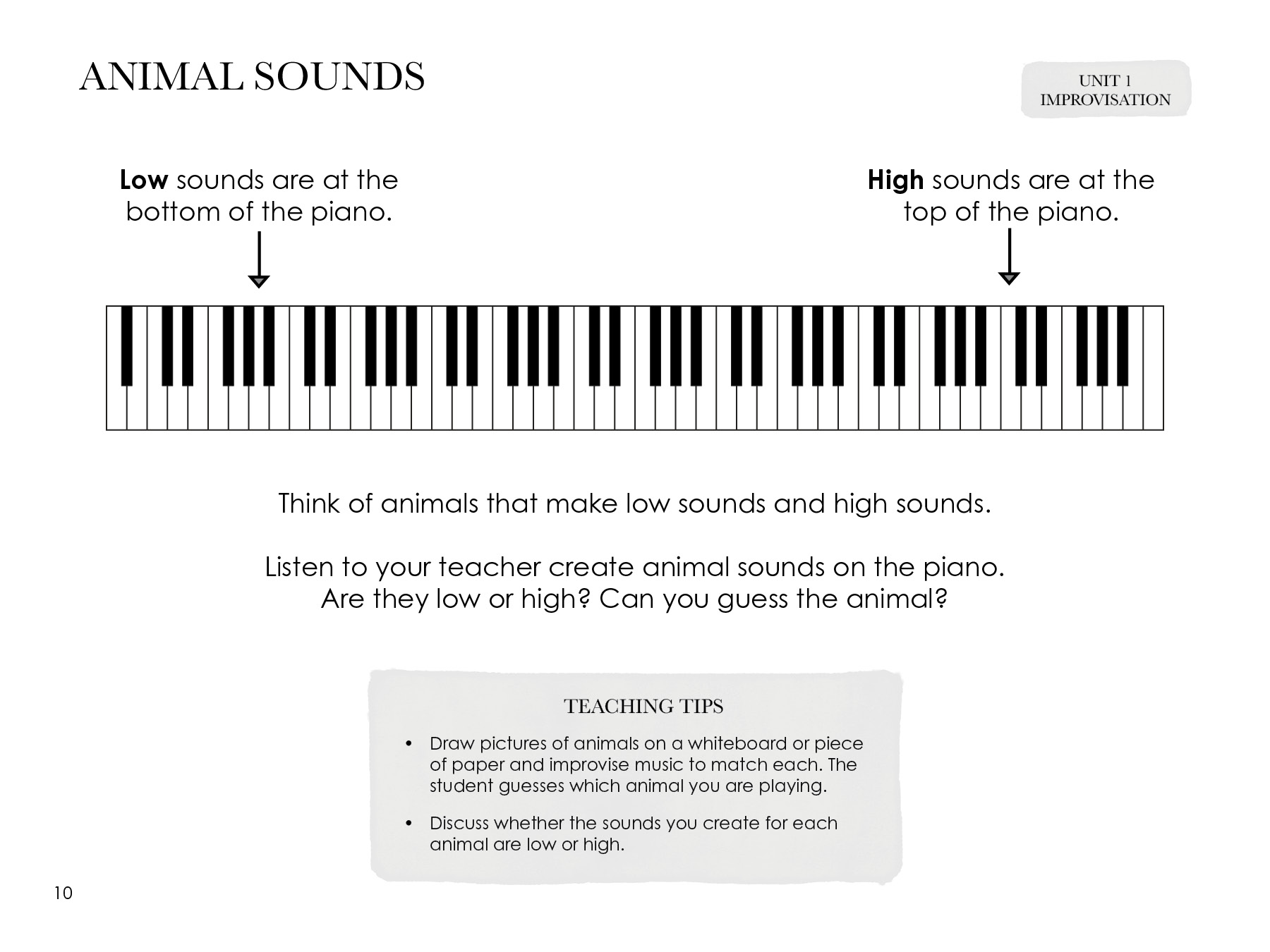
Along with your student, think about animals that make high and low sounds. In Piano Safari Friends, there is space for students to draw a picture of the animals they are thinking of, but they can also do this on a whiteboard or a blank sheet of paper.
Before creating sounds for the chosen animals on the piano, it is helpful to imitate the animal sounds with your voices. For example, create high and squeaky sounds for a mouse, or deep and slow sounds for a whale. After making the sounds with your voices, take turns improvising on the piano. I’ve found that some students will dive enthusiastically into this activity and begin experimenting with sounds, but for more reticent students it is highly advisable for you to demonstrate some ideas first. For additional inspiration, I’ve also had teachers mention that they’ve played recordings of the actual animal sounds for their students before improvising.
In my Piano Safari Friends class, we added a fun element where the group had to guess what animal the performing student was playing. Since some of the improvisations were hard to decipher, we also allowed the students to give verbal clues. Overall, this activity was joyful and every student was engaged and smiling. They left excited to share their animal sounds with their families!
Musical Thunderstorm
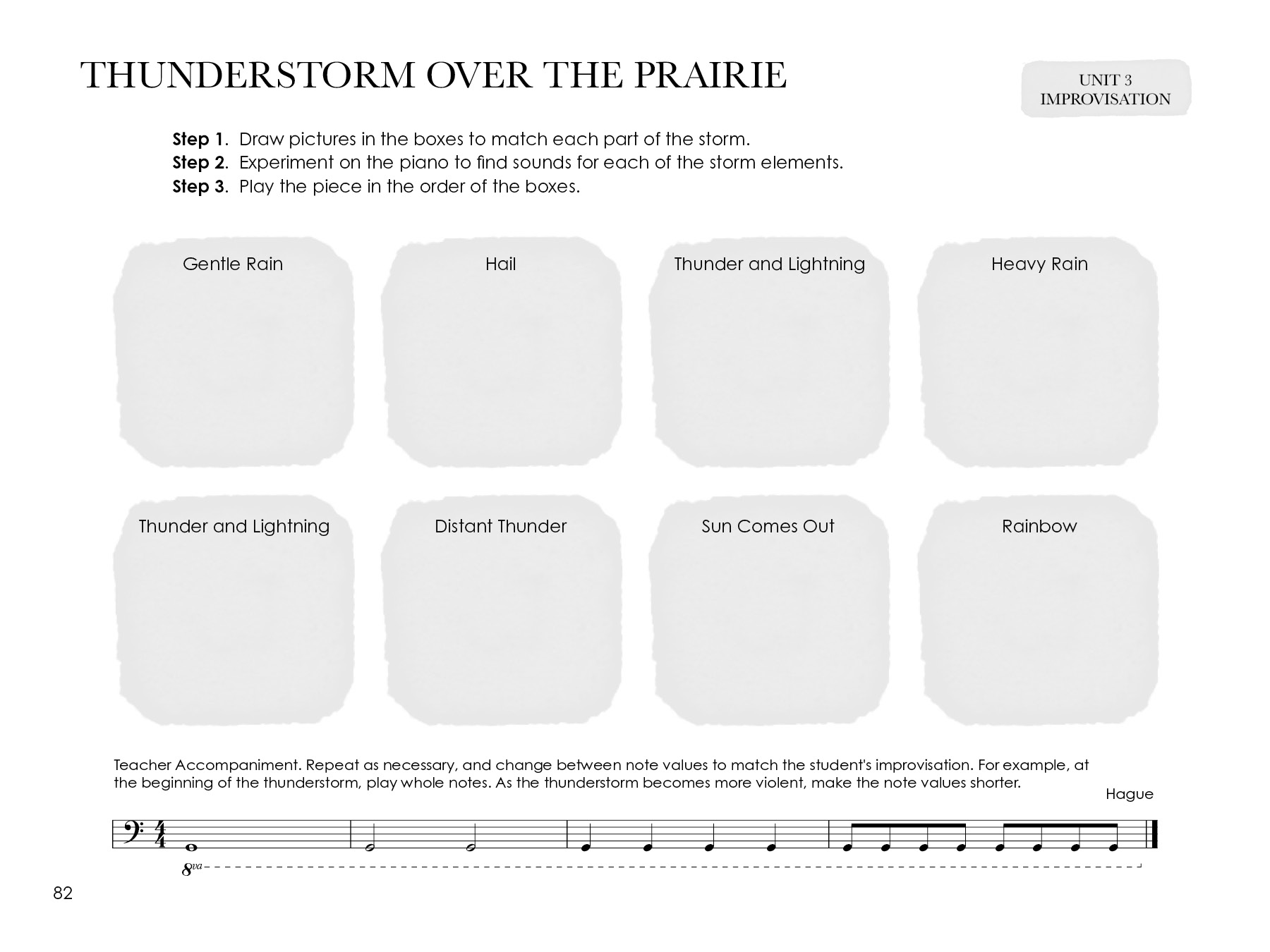
Repertoire Book 1 includes an improvisation called “Thunderstorm Over the Prairie.” Suggestions are provided for the different elements of a thunderstorm, and there is room on the page for student illustrations. Students create rain, thunder, lightning, hail, sun, and rainbow music. After they improvise sounds for each part individually, a teacher accompaniment is added and all of the elements are played together as one larger piece, which creates a musical thunderstorm!
This improvisation brings about a natural understanding of form. Students can change the order of the different thunderstorm elements to create a new piece every time. For example, maybe one day the thunderstorm begins with gentle rain, while another day it begins with thunder in the distance. To facilitate changing the order, I suggest that the student draw their storm elements on index cards so they can move them around easily.
What’s That Lurking In the Cave?
Our newest improvisation resource, Explore With Me!, is a set of six exploratory duets for beginning students to play with a more advanced pianist. Improvisation and rote playing are integrated into every duet, providing the opportunity to tell musical stories and create descriptive sounds across the entire keyboard. An added bonus are the stories for each duet written by composer Alison Mathews.
In the duet “What’s That Lurking in the Cave,” students learn a line by rote that sounds like someone cautiously tiptoeing into a cave. The next step (not pictured) is to improvise freely, creating sounds for “something slithering and something flittering,” while the teacher continues the tiptoe theme. Later in the piece, they improvise stomping sounds and end with a double glissando, a musical “roar!”
A portion of the teacher score is shown below, along with a student practice page from the end of the book. The student is able to tear out this page and place it next to the teacher score while playing with the accompaniment.
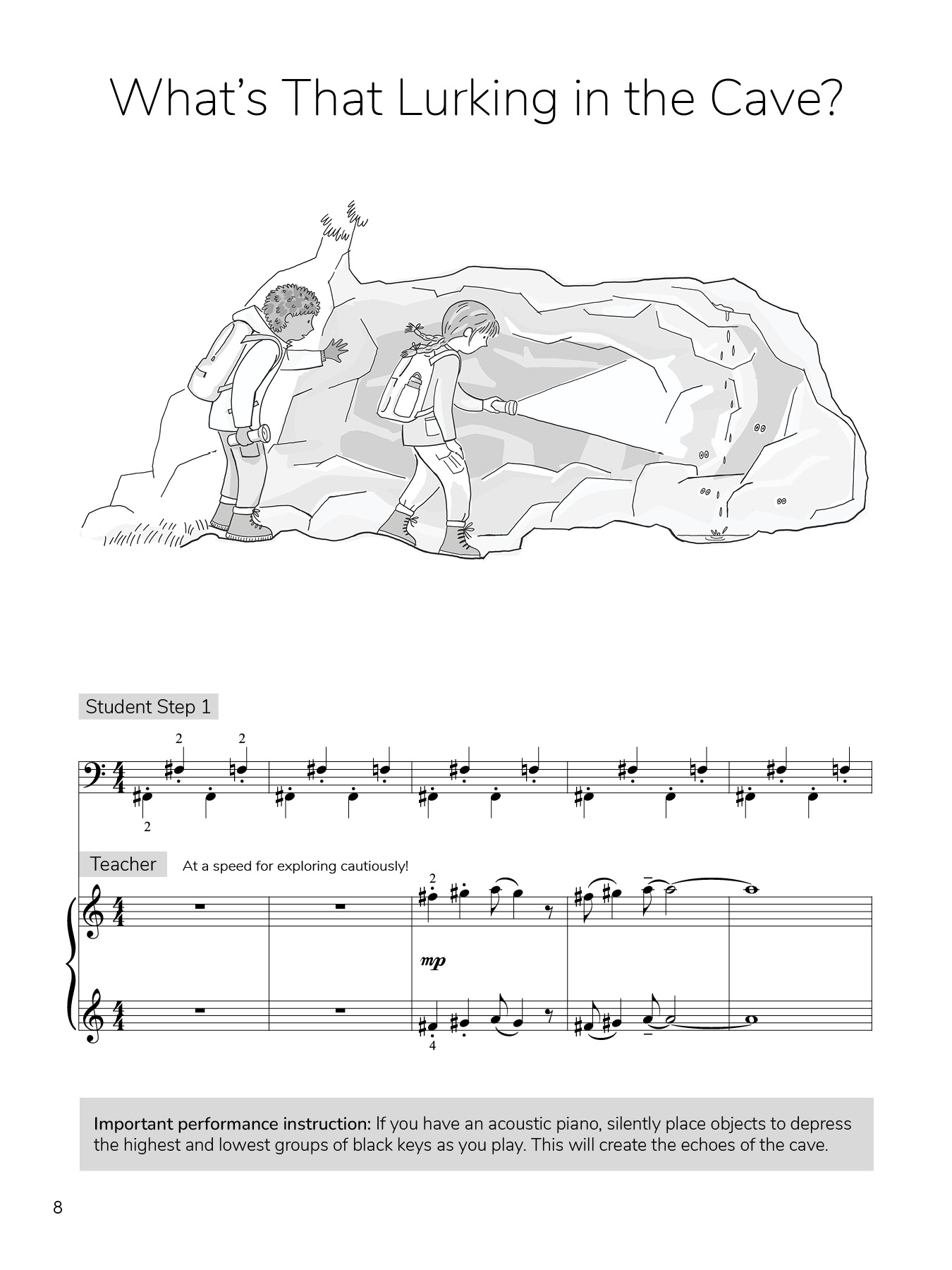
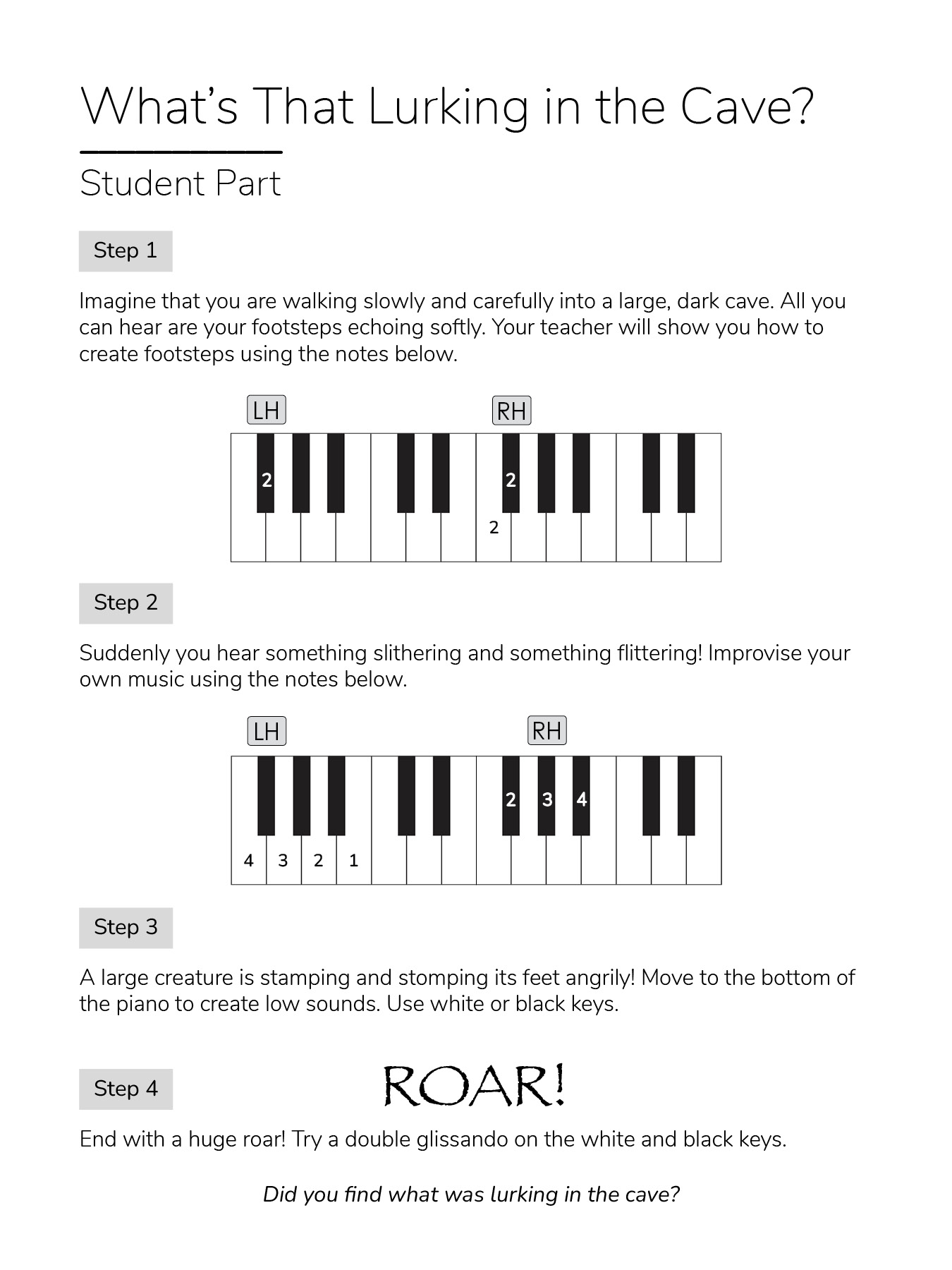
An added bonus in this piece is the special effect suggested by the composer. When the lowest and highest groups of three black keys are gently depressed while playing, (I suggest a using two mobile phones) it sounds like all of the notes are echoing in a cave! Students will love this!
Rhythmic Improvisation
In a rhythmic improvisation, the student uses a pre-established group of notes, but improvises the rhythm. This provides a harmonic and melodic framework for the student, leaving the emphasis on the rhythmic creation.
Journey Into Space
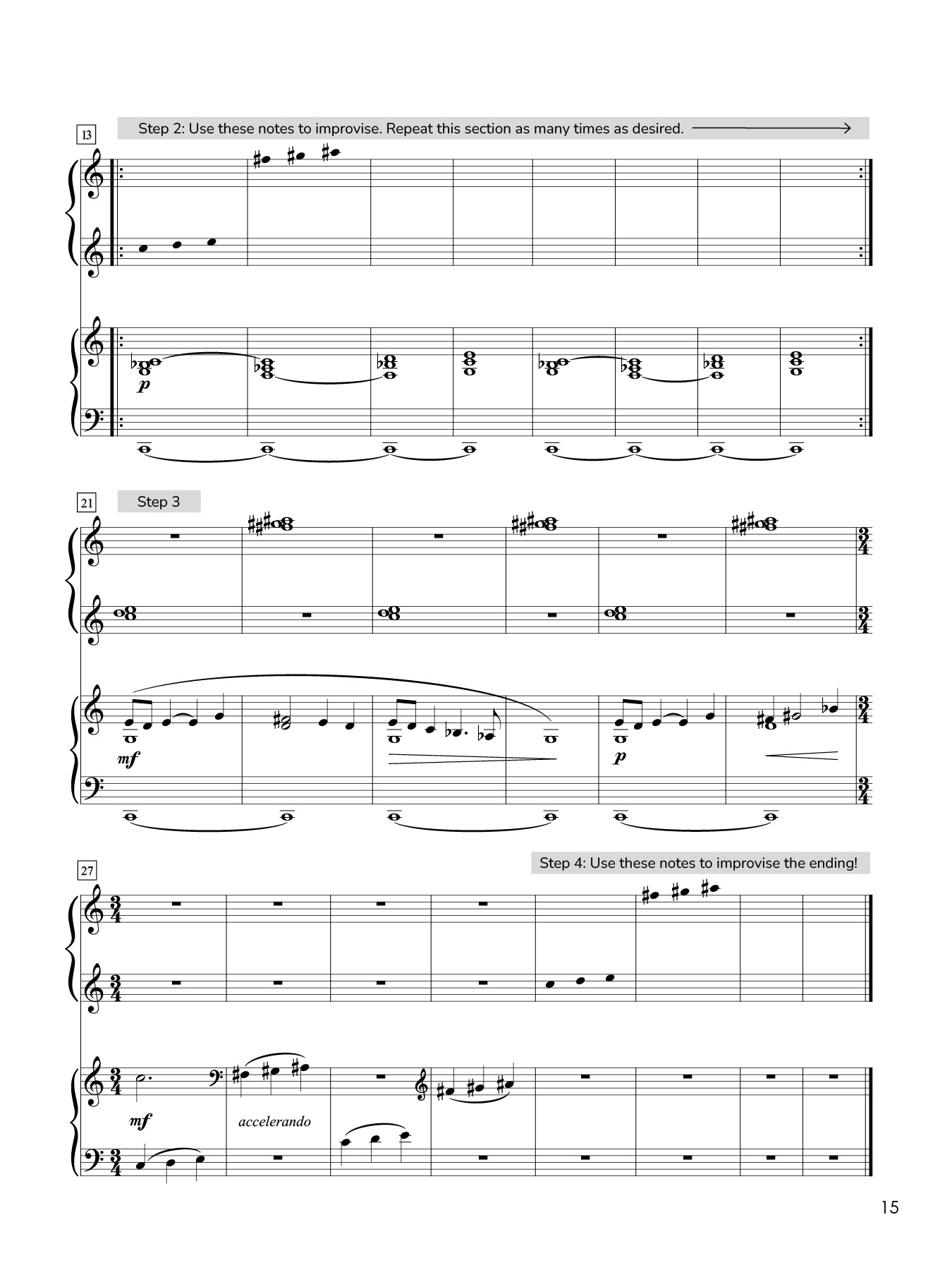
This improvisation duet from Explore With Me! begins with the student playing cluster chords alongside a mysterious sounding theme played by the teacher. Later in the duet, the student improvises using C, D, and E with the left hand and the group of three black keys with the right hand. The notes are established, but students are able to use any rhythm desired, in any octave desired.
Melodic Improvisation
In a melodic improvisation, the student uses a pre-established rhythm, but is directed to improvise by varying the notes. This provides a rhythmic framework for the student, leaving the emphasis on the melodic creation.
Shivers Up Your Spine
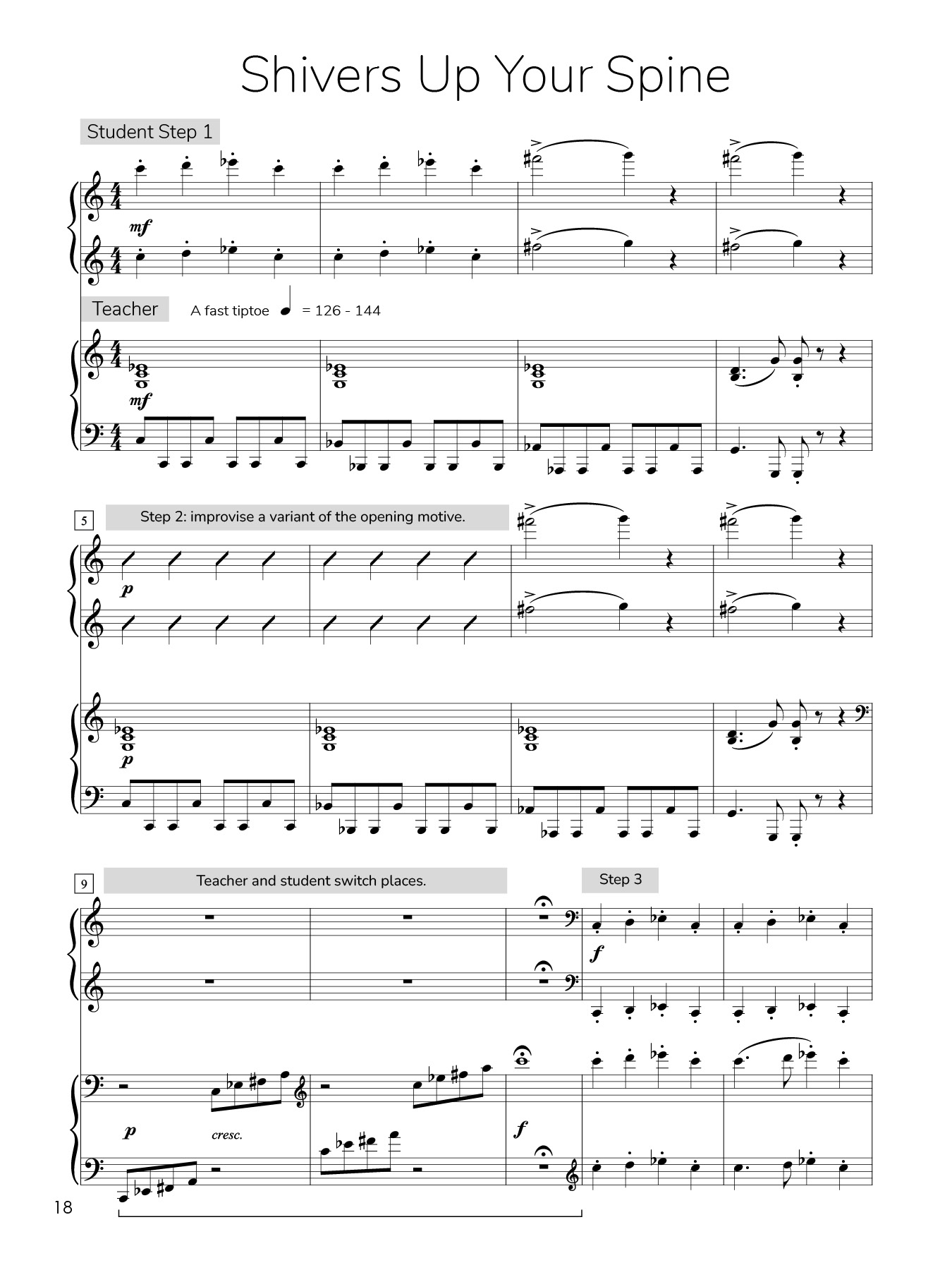
Students begin by learning the four-measure “Spooky Theme” by rote. Immediately following, they are asked to create a variant of the opening motive using all quarter notes. The rhythm is provided, but order of notes used in the melodic line will be improvised. This repeats again later in the piece, so students have more than one opportunity to improvise by changing up the melody.
For more information about Explore With Me! you may be interested in viewing the video sampler.
Sight Reading & Rhythm Cards
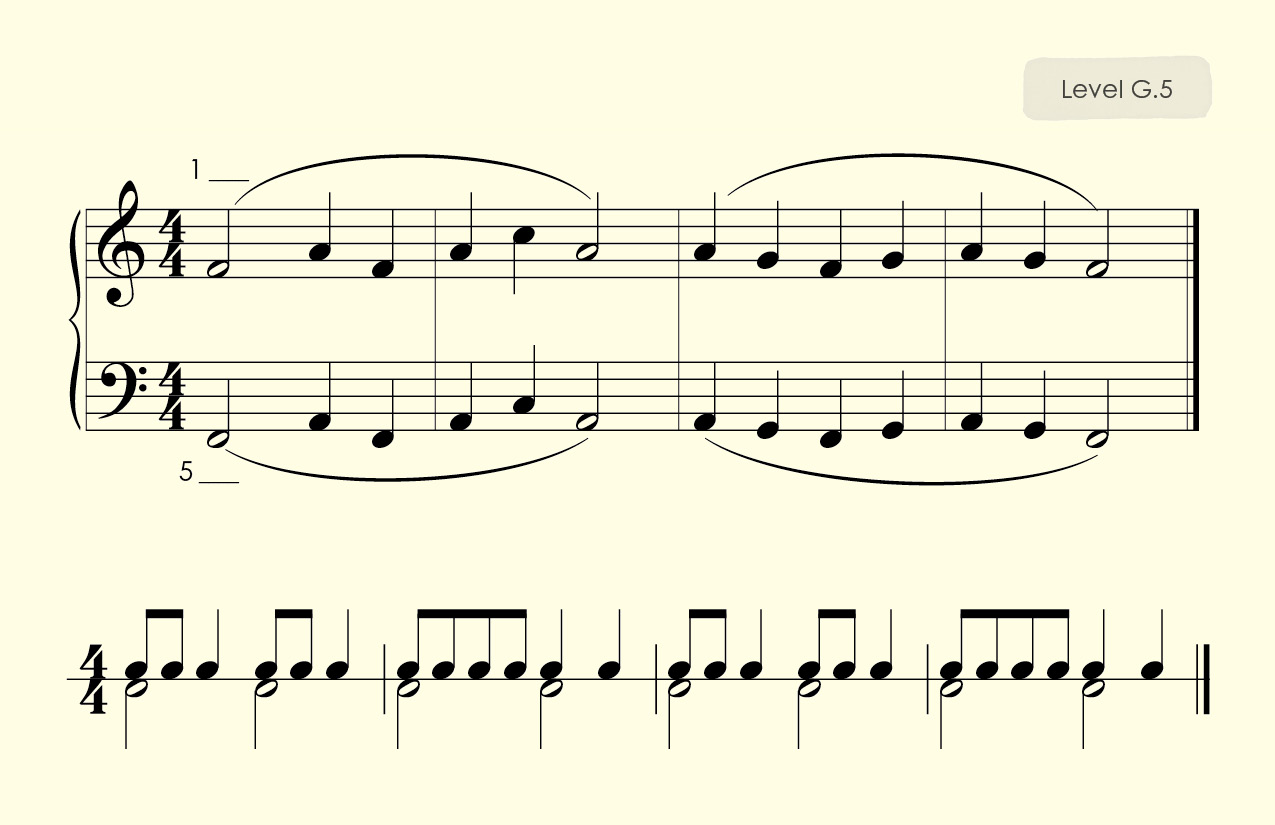
On each of the Piano Safari Sight Reading & Rhythm Cards, there is a rhythm tapping line across the bottom. Many teachers use this rhythm not only to tap, but to have students play. For example, in the card below, the student might choose a favorite pentascale pattern, such as D Minor, and play an improvised melody using the right hand with the indicated rhythm. The difficulty level can be adjusted. For example, four cards could be placed in a row on the music rack for greater length, or the student could add the left hand and harmonize their melody.
Summary
Improvisation is able to bring so much energy and joy into lessons! It provides a means for students to connect with music in an enjoyable and expressive way. Establishing the foundational belief that students are creators of music will be something they carry with them into the future.


